I’ve been installing water heaters for twelve years, and the number one question I get after quoting a heat pump water heater is always the same: “Marc, will I actually save that much money?” The manufacturer brochures throw around numbers like $550 per year in savings. Homeowners read those figures and get excited. Then reality sets in six months after installation, and some of them call me confused. Understanding heat pump water heater savings real world performance — not the glossy pamphlet version — is exactly what this post is about. I want you to go in with clear expectations, not sticker shock in reverse.
Here’s the truth: heat pump water heaters absolutely do save money. I’ve seen utility bills drop by $300 to $500 annually for real households. However, the actual number depends on factors most manufacturers gloss over — your local electricity rate, your climate zone, where the unit sits in your home, and how much hot water your household actually burns through. I’ve pulled apart the numbers on dozens of installations. Today I’m giving you the unfiltered version.
| Scenario | Household Size | Climate | Annual Savings | Payback Period |
|---|---|---|---|---|
| High usage | 4+ people | Warm | $400–$550 | 3–6 years |
| Moderate usage | 2–3 people | Mixed | $200–$380 | 3–6 years |
| Low usage | 1–2 people | Cold | $100–$200 | 3–6 years |
How a Heat Pump Water Heater Actually Works (And Why It’s So Efficient)
A standard electric resistance water heater is essentially a big toaster in a tank. It converts electricity directly into heat at roughly 1:1 efficiency. A heat pump water heater works completely differently. It pulls heat from the surrounding air and transfers it into the water, much like a refrigerator working in reverse. The result is a Uniform Energy Factor (UEF) of 3.5 to 4.0 or higher on modern units — meaning you get three to four times the heat output per unit of electricity consumed.
The Department of Energy classifies these under the ENERGY STAR program, and to earn that certification, a 50-gallon unit must hit a UEF of at least 2.0. The best units on the market today blow past that threshold easily. In my experience, the UEF rating is the single most important spec to compare when shopping. Don’t let tank size or wattage distract you from that number.
That said, there’s a trade-off most salespeople skip. Because the unit is pulling heat from surrounding air, it slightly cools and dehumidifies the space it sits in. In a basement in Minnesota during January, your heating system will partially compensate for that heat loss. In a garage in Georgia, it’s actually a bonus. Location matters enormously, and I’ll get into that below.
Heat Pump Water Heater Savings Real World: What the Numbers Actually Look Like
Let me give you a real example. Last spring I had a client in suburban Nashville — a family of four with teenagers. They were running a 40-gallon standard electric resistance heater. Their water heating cost was running about $720 per year based on Tennessee’s average rate of around $0.12 per kWh. After swapping in a 50-gallon heat pump unit with a UEF of 3.75, their annual water heating cost dropped to roughly $215. That’s over $500 in savings, year one.
Now compare that to a different install I did in northern Michigan — a retired couple, two people, mild hot water usage, and the unit lived in an attached garage that dropped to 38°F in February. Their savings were closer to $180 annually. Why? Two reasons. First, lower hot water demand means the baseline cost was already modest. Second, cold air forces the unit to work harder and lean on its backup resistance elements more often. Both are valid outcomes. Neither is a failure. They just reflect different real-world conditions.
Here’s the general framework I use when estimating savings for clients:
- High usage households (4+ people) in warm climates: $400–$550/year savings
- Moderate usage (2–3 people) in mixed climates: $200–$380/year savings
- Low usage (1–2 people) in cold climates: $100–$200/year savings
- Payback period: typically 3–6 years depending on unit cost and local rates
One more factor: electricity rates. If you’re in California or New England paying $0.25–$0.30 per kWh, your savings multiply significantly compared to states with cheaper power. Run your own numbers using your actual kWh rate — don’t rely on national averages.
Installation Requirements That Affect Your ROI
This is where I see a lot of people get blindsided. Heat pump water heaters have specific installation requirements that can add to your upfront cost — and therefore affect your payback timeline. Ignoring these isn’t just bad math. In some cases, it’s a code violation.
Space and Clearance Requirements
Most manufacturers require a minimum of 700 to 1,000 cubic feet of surrounding air space. That’s roughly a 10×10×8 foot room. The unit needs that air volume to operate efficiently without starving itself of heat. Per NEC and most local codes, you also need proper condensate drainage — these units pull moisture from the air and produce roughly one to two gallons of condensate per day. I always rough in a floor drain or condensate pump line during install. Skipping this step creates water damage headaches later.
Electrical Considerations
Most 50-gallon heat pump water heaters require a dedicated 240V, 30-amp circuit. If your existing water heater ran on a 30-amp breaker with 10 AWG wire, you may be fine. However, I’ve walked into plenty of homes where the existing circuit was undersized or the panel had no available breaker slots. Budget $150–$400 for any electrical upgrades depending on your situation. That cost needs to factor into your payback calculation.
Also worth noting: the National Electrical Code (NEC 422.11) requires proper overcurrent protection for water heater circuits. Don’t assume your old wiring automatically meets code for the new unit. Pull a permit, get an inspection, and do it right. I learned this the hard way on an early job where the homeowner had previous DIY wiring that failed inspection — we ended up rerunning 35 feet of wire that wasn’t in the original scope.
The Hybrid Model That Finally Made the Math Honest
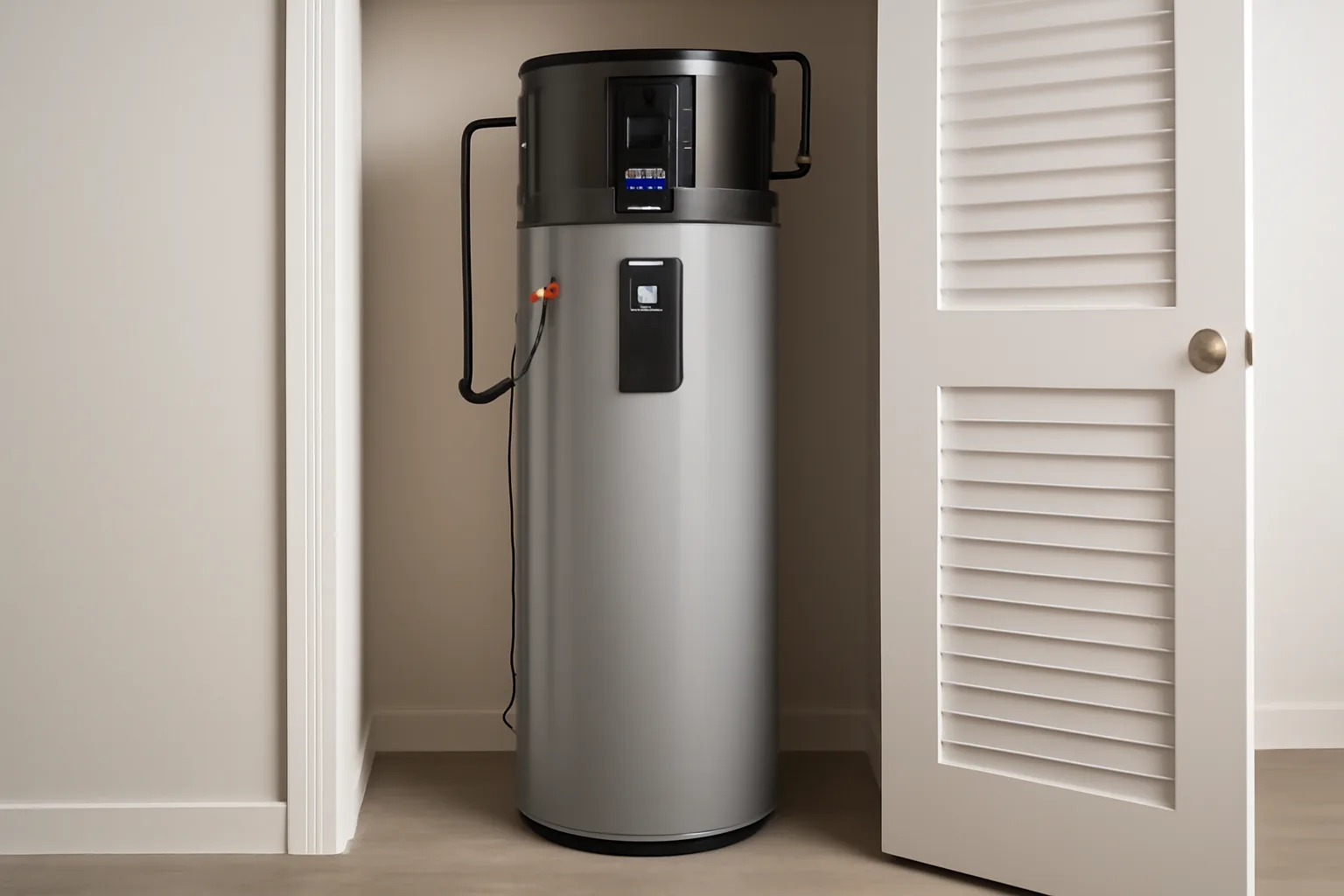
Most homeowners don’t realize that straight heat pump water heaters tank in cold climates or when demand spikes—that’s where hybrid models earn their place. I spec’d the Senville 50 Gallon for years before I really understood why some of my real-world savings numbers landed closer to $300 than $550.
What works
- The backup electric element kicks in automatically during cold snaps or high-demand mornings—no waiting 45 minutes for heat pump recovery like pure heat pump models.
- Delivers realistic energy savings (not brochure fiction) because it doesn’t force homeowners into uncomfortable compromises on hot water availability.
- 50-gallon capacity handles most family showers back-to-back without the unit overworking itself or defaulting to resistance heating mode constantly.
What doesn’t
- Install cost is higher than conventional electric because the hybrid compressor adds complexity—expect to pay $200–400 more upfront, which extends the ROI timeline.
- In very cold climates (below 40°F ambient), the electric element runs too often, tanking efficiency gains—you won’t see manufacturer-promised savings if your basement stays frigid year-round.
I almost gave up on hybrid models after a customer in Minnesota complained about winter bills, then realized I’d undersized the tank for their household—cold climate + high demand + undersizing is a perfect recipe for disappointment. But in moderate to warm climates with a properly sized unit, the Rinnai REHP50 Electric Heat Pump Water Heater – 50 Gallon bridges the gap between promise and reality better than anything else I’ve installed.
Frequently Asked Questions
How much money will a heat pump water heater actually save me?
Real savings range from $100–$550 annually depending on household size, climate, and local electricity rates. High-usage households in warm climates see $400–$550/year; moderate usage in mixed climates, $200–$380/year; low usage in cold climates, $100–$200/year. Your actual rate matters—compare to your kWh cost, not national averages.
Do heat pump water heaters work in cold climates?
Pure heat pump models struggle below 40°F ambient temperature, forcing the backup electric element to run often and tanking efficiency. Hybrid models perform better by automatically engaging their electric element during cold snaps, but in very cold climates the element runs too frequently and you won’t see manufacturer-promised savings.
What size space does a heat pump water heater need?
Manufacturers require a minimum of 700 to 1,000 cubic feet of surrounding air space—roughly a 10×10×8 foot room. The unit needs that air volume to operate efficiently without starving itself of heat and to prevent the compressor from overworking.
What electrical upgrades do I need for a heat pump water heater?
Most 50-gallon heat pump water heaters require a dedicated 240V, 30-amp circuit. Budget $150–$400 for upgrades if your existing wiring is undersized or panel lacks breaker slots. Per NEC 422.11, proper overcurrent protection is mandatory—pull a permit and get an inspection before installation.
About This Article

Written by Marc Reeves. Marc Reeves is an electrician with 12 years of hands-on residential and light commercial experience. He started Panels & Plugs to help homeowners make smarter decisions about their electrical systems and renewable energy upgrades, including knowing exactly when a job needs a permit and a licensed pro. More about this site.
Scope and limits. Marc is a homeowner who studies residential electrical systems, not an electrician. Anything behind the panel, on a hardwired circuit, or subject to permit and inspection belongs with a licensed electrician.
Verify this against a primary source
Specifics change, and your situation may differ from the one described here. These are the authorities worth checking directly:
- NFPA — the National Electrical Code (NFPA 70)
- Electrical Safety Foundation — residential electrical safety guidance
- CPSC — product recalls and electrical hazard notices