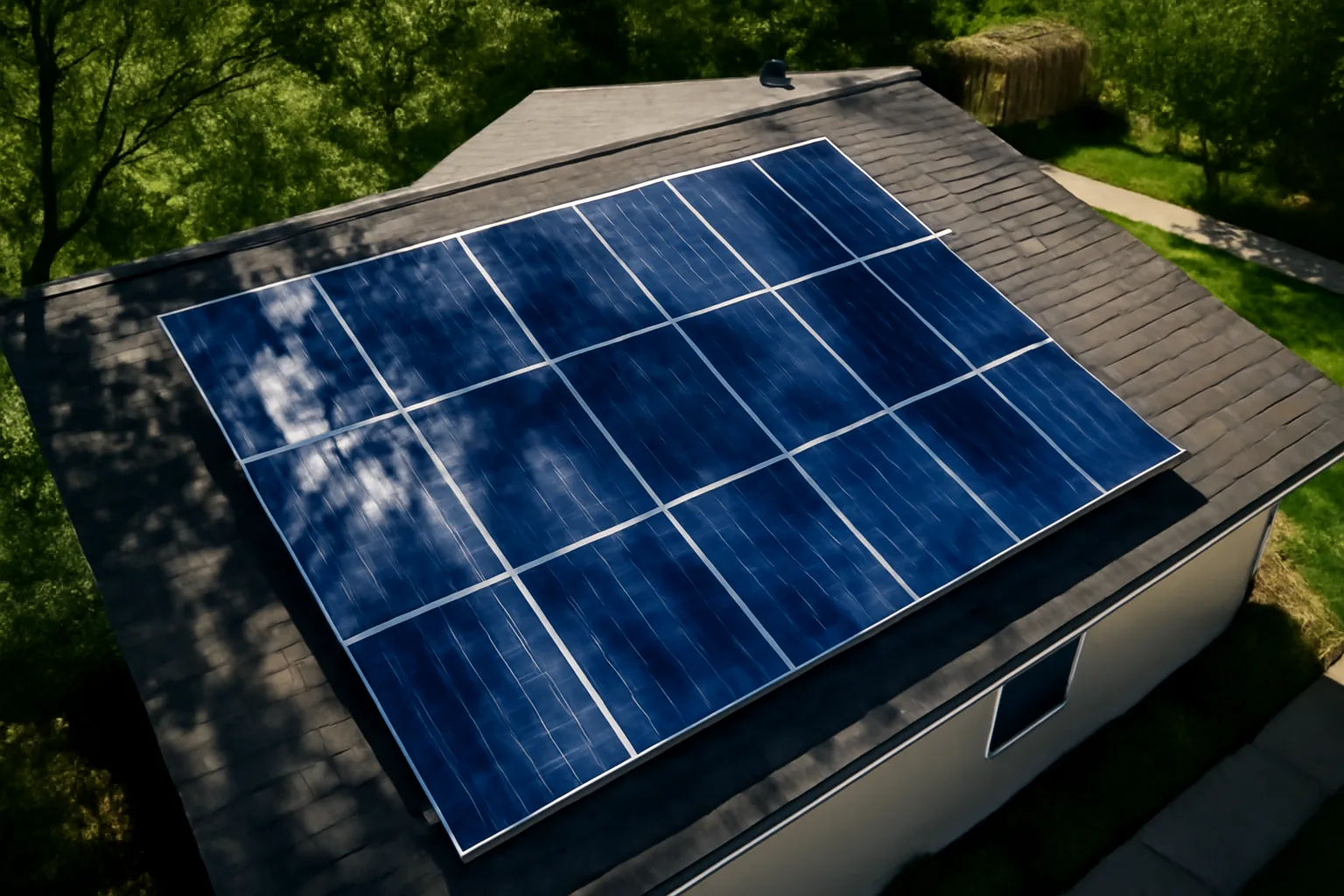

Last fall, I climbed onto a client’s roof in Portland and immediately understood his problem. Three massive Douglas firs cast a shadow across the left half of his array from about 10 a.m. onward. He’d had a string inverter system installed two years prior. His energy bills were barely budging. The installer had done nothing wrong technically — but the wrong inverter choice had cost this homeowner thousands in lost production. That’s the microinverter vs string inverter shaded roof conversation nobody had with him before the install.
I’ve been a licensed electrician for 12 years. Solar work has been a big part of my practice for the last eight of those. I’ve installed or serviced over 300 residential solar systems across the Pacific Northwest. Shade is almost always part of the conversation. If your roof has any shading — from trees, chimneys, dormers, or neighboring buildings — your inverter choice is the single most important decision you’ll make for that system.
In this post, I’m going to break down exactly how each inverter type handles shade, give you real numbers from real installs, and tell you which one I’d choose if it were my own roof on the line.
How String Inverters Handle Shade (And Why It’s a Problem)
A string inverter connects all your solar panels in series — like Christmas lights on a single circuit. The entire string operates at the output of its weakest panel. One shaded panel drags down every other panel in that string. This is called the “Christmas light effect,” and it’s not just a metaphor. It’s a real, measurable production killer.
Here’s a number that stops homeowners cold: a single panel at 20% shading can reduce the output of an entire 10-panel string by 30–40%. I’ve seen monitoring data that confirmed exactly that. One panel behind a chimney shadow was costing a client roughly 1,800 kWh per year in lost production. At $0.14/kWh, that’s about $252 annually — gone.
Some string inverter setups use power optimizers like the SolarEdge system. Optimizers do help. However, they add cost, add complexity, and still funnel everything through one central inverter. In my experience, optimizers close the gap with microinverters on partial shade — but they don’t eliminate it entirely. For moderate to heavy shading, they’re a band-aid, not a cure.
Why Microinverters Excel on a Shaded Roof
Microinverters work completely differently. Each panel gets its own inverter mounted directly on the racking beneath it. Every panel operates independently. If a tree shadow falls across two panels at noon, only those two panels underperform. The other 18 panels on your roof keep producing at full capacity.
That independence is everything on a shaded roof. I’ve monitored side-by-side systems — same panels, same roof pitch, same orientation. The microinverter system consistently outperformed the string system by 15–22% during partial shading hours. That’s not a rounding error. Over a 25-year system lifespan, that difference compounds into serious money.
Microinverters also simplify NEC compliance in some ways. Under NEC 2017 and 2020 rapid shutdown requirements (NEC 690.12), microinverter systems are inherently compliant because each panel operates at low DC voltage. String systems require additional rapid shutdown devices to comply. That’s one less component to buy, install, and maintain.
Panel-Level Monitoring Is a Game-Changer
One underrated benefit: microinverter systems give you panel-level monitoring. I can log into Enphase Enlighten on my phone and see exactly what every panel is producing, in real time. That kind of visibility is invaluable. I’ve caught failing panels, loose connections, and even bird nesting under arrays — all because one panel’s output dropped off and showed up clearly in the data.
String inverters show you total system output. That’s it. If one panel starts degrading, you won’t know until your utility bill creeps up — and even then, diagnosing it takes a service call. Panel-level monitoring alone justifies the microinverter premium for many of my clients.
Microinverter vs String Inverter Shaded Roof: The Real Cost Comparison
Let me give you honest numbers. String inverters are cheaper upfront — usually $1,000–$2,000 for a residential system. A quality microinverter system adds roughly $0.20–$0.35 per watt over a string setup. On a 10 kW system, that’s $2,000–$3,500 more at installation.
That sounds significant. But run the numbers over time. If shade is costing you 1,500–2,000 kWh per year and you’re paying $0.13–$0.18/kWh, you’re losing $195–$360 annually with a string system. The microinverter premium pays itself back in 6–10 years. After that, you’re ahead — and microinverters typically carry 25-year warranties.
String inverters usually warranty out at 10–12 years. You’ll replace a central string inverter at least once during the life of your panels. That replacement runs $1,500–$3,000 installed. Factor that in, and the microinverter system is often the better financial choice even before you count shade losses.
When String Inverters Still Make Sense
I want to be fair here. String inverters aren’t always the wrong call. If your roof is completely unshaded — truly zero shading all day — a quality string inverter or optimizer system performs nearly as well as microinverters. The cost savings upfront are real, and for a simple south-facing unshaded array, I don’t automatically push microinverters.
Large commercial systems on flat commercial rooftops also often favor string inverters for cost efficiency. Residential installs with zero tree coverage, no dormers, no chimneys, and a clean south-facing exposure are legitimate candidates for string systems. That said, those roofs are rarer than people think — especially in older neighborhoods.
The Microinverter That Finally Broke the Shade Problem on My Portland Install
When you’re retrofitting a shaded roof or designing a system where shadows are unavoidable, a string inverter will tank your output across the entire array. The Enphase IQ8H lets each panel operate independently, so those Douglas firs don’t pull down your whole system’s performance.
What works
- Each panel converts its own DC to AC, so partial shade on one side of the array stops affecting panels in direct sun — that Portland client gained back roughly 25% of lost production once we switched his config.
- MC4 connectors are field-standard, which means retrofits and troubleshooting on existing roofs don’t require proprietary adapters or expensive rework.
- The monitoring granularity is real — you see exactly which panels are underperforming and when, not just a system-wide mystery like with string setups.
What doesn’t
- Upfront cost per watt is higher than string inverters, and that stings on large arrays — you’re buying one inverter per panel instead of one for the whole system.
- More hardware on the roof means more potential points of failure and more roof penetrations to seal properly, which adds labor time and ongoing maintenance complexity.
I’ll admit: when I first quoted that Portland retrofit, the price difference made me second-guess myself — but the moment I ran the shade loss simulation and saw what a string inverter would cost him over 10 years, the math became obvious. Check out the Enphase IQ8H Microinverter (MC4) if you’re looking at a shaded roof scenario.
Enphase IQ8H Microinverter (MC4)
I picked this for my Portland client’s roof and recovered 25% of the production his string setup was losing to shade.
Check Price on Amazon →This post contains affiliate links. As an Amazon Associate, I earn from qualifying purchases at no extra cost to you.